
How to better find a walkie-talkie that suits your own use—congratulations, here you may find the answer that belongs to you.
Johnson Wu
Choosing a professional DMR digital two-way radio for business is not simply a matter of comparing transmission power or selecting the model with the most features. For companies operating in manufacturing plants, warehouses, hotels, construction sites, and security environments, the right radio system must support reliable communication, efficient team coordination, and consistent daily operation.
Digital Mobile Radio (DMR) technology provides businesses with digital voice communication, individual and group calling, messaging, and other communication management functions. However, not every DMR radio offers the same capabilities. Frequency range, DMR tier, battery performance, channel capacity, encryption, and repeater compatibility all affect whether a device is suitable for a particular working environment.
HYDX provides a range of professional digital communication products for commercial and industrial users. This guide explains the key factors businesses should evaluate before purchasing a professional DMR digital two-way radio and how to identify a suitable solution for their communication requirements.
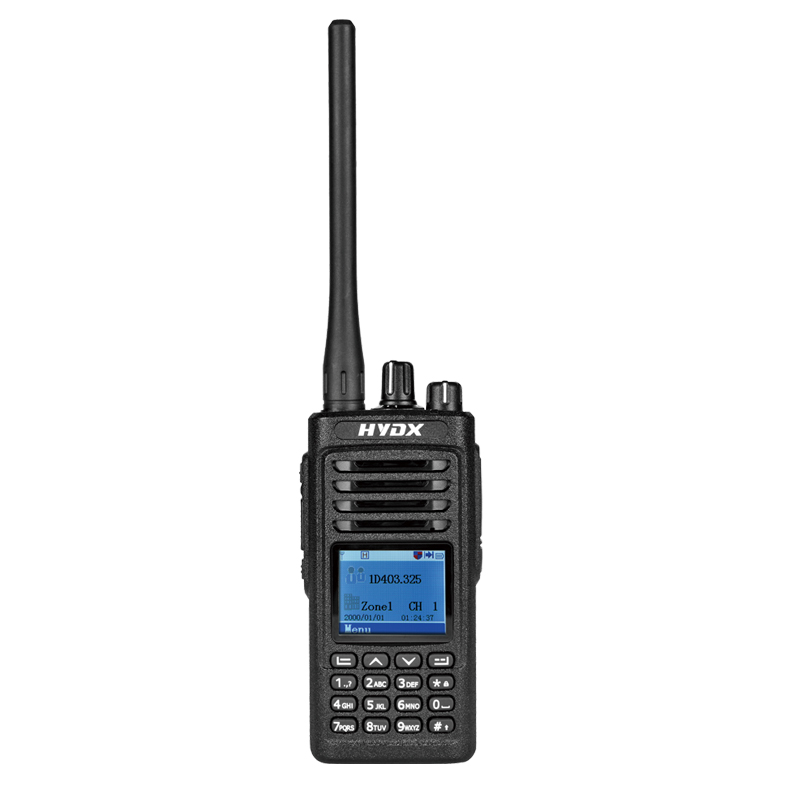
Professional handheld DMR digital two-way radio from HYDX
DMR stands for Digital Mobile Radio, a digital radio communication standard developed for professional land mobile radio applications. Unlike traditional analog radios, DMR converts voice into digital signals before transmission, allowing compatible devices to communicate through a structured digital system.
One important technical advantage of DMR is its use of two-slot Time Division Multiple Access (TDMA). Under the standard 12.5 kHz channel arrangement, TDMA divides communication into two alternating time slots, allowing two logical communication paths to share the same radio frequency channel.
This makes DMR particularly useful for businesses that need to coordinate several teams without assigning a separate frequency channel to every communication group.
Depending on the radio model and system configuration, DMR communication can support:
For businesses considering a digital upgrade, the HYDX DMR digital radio product range provides different product categories for commercial and professional communication requirements.
DMR radios are commonly classified into Tier I, Tier II, and Tier III. Understanding these categories helps businesses identify the communication system they actually need instead of paying for functions that may not be necessary.
DMR Tier I is generally associated with license-free or lightly regulated personal and small-scale communication applications, depending on regional regulations. It is designed for relatively simple communication requirements and does not provide the same licensed conventional system capabilities as Tier II.
DMR Tier II is widely used in professional commercial and industrial radio systems. It supports licensed conventional operation, direct radio-to-radio communication, and repeater-assisted communication.
For businesses such as logistics companies, security teams, manufacturing facilities, and construction contractors, Tier II is often a practical choice when more organized team communication and expandable coverage are required.
DMR Tier III is designed for trunked radio systems that dynamically allocate available communication resources among users. It is more suitable for large-scale organizations with complex communication networks, multiple departments, and centralized system management requirements.
When selecting a radio, businesses should verify the supported DMR tier and system compatibility rather than assuming that all digital radios can communicate with one another. The frequency, color code, time slot, talkgroup, and programming configuration must also be compatible.
Frequency selection has a direct influence on how a two-way radio performs in different environments. Professional DMR radios commonly operate in UHF or VHF frequency bands, but the appropriate option depends on the operating location and local radio regulations.
UHF radios are frequently selected for warehouses, factories, shopping centers, hotels, and other environments containing walls, equipment, and multiple indoor communication areas. They are often practical for businesses that need portable communication across buildings and indoor workspaces.
VHF radios are commonly considered for outdoor environments with fewer physical obstructions, including open industrial sites, agricultural operations, and certain outdoor service applications.
However, frequency alone does not determine actual communication distance. Antenna performance, transmitter power, receiver sensitivity, terrain, building materials, interference, and repeater placement all affect coverage.
Businesses with wider communication areas should also consider whether a repeater is needed. A compatible repeater can extend coverage by receiving and retransmitting radio signals, particularly where direct radio-to-radio communication is insufficient.
Channel capacity determines how communication groups can be organized within a radio system. A small business with a single working team may only require a limited number of channels, while a large facility with security, maintenance, warehouse, and management departments may need a more flexible configuration.
Before purchasing a professional DMR digital two-way radio, consider the following functions:
For example, the HYDX D200 digital two-way radio supports 32 channels and 1,024 digital contacts, together with private, group, and all-call functions. It also supports direct mode and repeater operation, making it an option worth evaluating for businesses that need organized digital communication.
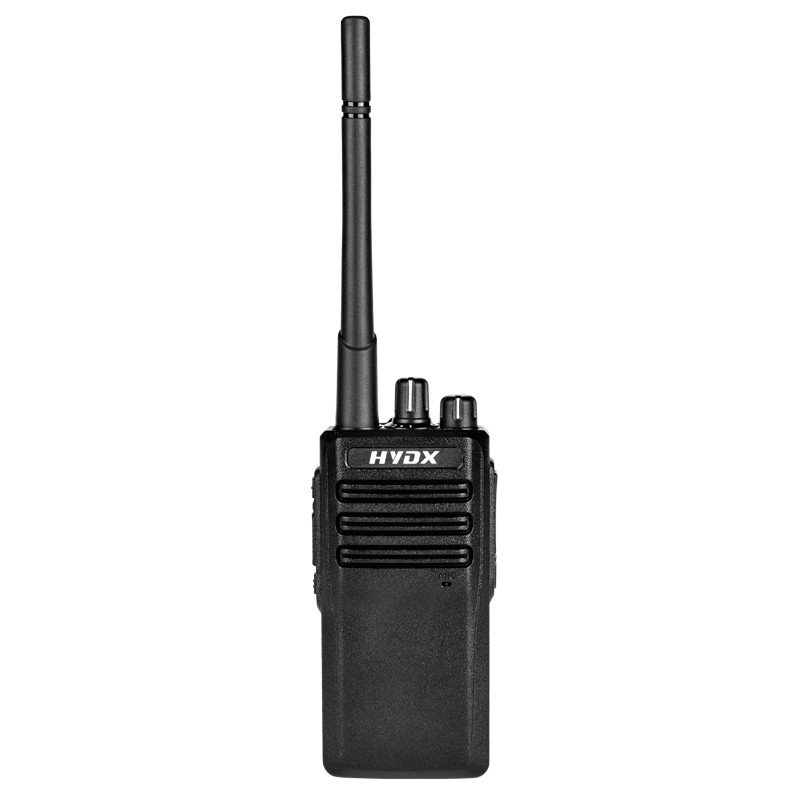
HYDX D200 commercial digital two-way radio
Explore the HYDX D200 handheld commercial digital radio for its detailed technical specifications and supported communication functions.
Battery performance is an important consideration for employees who rely on two-way radios throughout long working shifts. A radio that requires frequent charging can interrupt communication and create additional equipment management work.
When comparing battery specifications, businesses should look beyond battery capacity alone. Actual operating time is affected by transmit and receive ratios, standby time, transmission power, GPS usage, display settings, and other active functions.
For procurement purposes, consider the following questions:
For example, the HYDX D50 is a commercial DMR handheld radio with a high-capacity battery design and selectable 4W/1W output power. Its product specifications should be reviewed together with the intended operating schedule to determine whether it meets a particular team's requirements.
Commercial DMR handheld radio with LCD display and keypad
A professional radio must remain practical in real working conditions. In noisy factories, busy construction sites, and outdoor industrial environments, clear audio and a durable housing can make a significant difference to everyday communication.
Digital voice communication can provide consistent and intelligible audio within the usable coverage area. However, audio quality still depends on receiver performance, speaker output, microphone design, signal strength, and the surrounding environment.
Businesses should evaluate speaker clarity and microphone performance in conditions similar to their actual workplaces.
For radios used outdoors or in demanding industrial environments, check the enclosure protection rating, operating temperature range, and resistance to dust, water, and impact.
An IP rating should be checked against the specific model's official certification and test conditions. Do not assume that every professional DMR radio is waterproof or suitable for hazardous locations.
Some DMR radios support digital voice encryption to help protect sensitive business communications. However, encryption capabilities vary significantly between models.
For organizations handling confidential information, verify the supported encryption algorithm, key management method, compatibility with other devices, and any applicable regulatory requirements. A product description mentioning encryption does not automatically mean that every encryption option is available on every configuration.
For businesses with higher security requirements, the HYDX D35Plus professional AES128/256 digital radio offers optional ARC4/AES128/AES256 encryption, recording, and 64-channel capacity.
Compatibility is especially important for businesses upgrading from analog radios or expanding an existing digital communication network.
A dual-mode radio that supports both analog and digital transmission can help businesses manage a gradual transition. Existing analog equipment may continue operating while compatible DMR devices are introduced into the communication system.
However, simply supporting the same frequency band does not guarantee communication between two radios. Before placing an order, confirm the following:
For larger projects, it is advisable to request a sample unit and test communication with the existing equipment before purchasing radios in bulk.
The best professional DMR digital two-way radio depends on the working environment, communication structure, and operational requirements of the organization.
Production facilities often require continuous coordination between operators, supervisors, maintenance personnel, and warehouse staff. Group calling, clear audio, channel scanning, and reliable battery performance are important considerations.
Warehouse teams need efficient communication between receiving, inventory, picking, packing, and dispatch departments. UHF handheld DMR radios can be considered for indoor communication, subject to coverage testing across storage racks and building layouts.
Security teams often require individual calls, group communication, priority channels, and dependable audio. Encryption may also be relevant when the communication involves sensitive operational information.
Hotels, shopping centers, and large commercial facilities need communication between front-desk staff, housekeeping, maintenance, and security teams. Compact handheld radios with practical channel organization can help improve daily coordination.
Rather than selecting one radio for every application, businesses should compare the actual requirements of each team and choose a suitable configuration.
HYDX is a two-way radio brand operated by Fujian Juston Electronic Equipment Co., Ltd. Established in 2011, the company focuses on the research, development, manufacturing, and global marketing of wireless communication equipment.
Its DMR product portfolio covers different professional and commercial communication requirements, with models offering different combinations of digital and analog operation, channel capacity, battery configurations, recording, and encryption functions.
For businesses evaluating HYDX products, several models offer useful starting points for comparison:
These models are designed for different requirements, so the most appropriate choice should be based on the actual project specifications rather than model names or feature counts alone.
HYDX also provides OEM-related customization services, including customized packaging design and printing. For distributors, importers, and business buyers, it is useful to discuss product configuration, order quantities, accessories, and technical support before confirming an order.
Before selecting a supplier or placing a bulk order, use this checklist to make sure the proposed radio system meets your business requirements:
A professional DMR digital two-way radio should be selected according to how your employees communicate, where the equipment will be used, and how the communication system may expand in the future. By evaluating these factors carefully, businesses can build a more reliable and efficient communication solution.
HYDX offers a range of digital radio products for commercial and professional applications. Contact the HYDX team to discuss your operating environment, required features, and suitable DMR radio configurations.
A professional DMR digital two-way radio is a communication device based on the Digital Mobile Radio standard. It converts voice into digital signals and supports functions such as individual calling, group calling, digital messaging, and repeater communication, depending on the model.
DMR Tier I is generally intended for simpler, license-free or lightly regulated applications, depending on regional regulations. DMR Tier II is designed for licensed conventional professional radio systems and supports direct and repeater-assisted communication.
DMR radios offer digital communication features, two-slot TDMA operation, and functions such as individual and group calling. Analog radios may be more suitable for simpler communication requirements or existing analog systems. The right choice depends on budget, compatibility, coverage, and operational needs.
Some DMR radios support both analog and digital operating modes. However, communication requires compatible frequencies, channel settings, and operating configurations. A DMR-only radio cannot automatically communicate with every analog device.
The required number depends on the number of communication teams and how departments are organized. Smaller teams may need only a few channels, while larger facilities may require more channels and zones. The HYDX D200, for example, supports 32 channels.
No. DMR radios can communicate directly when operating in direct mode. A repeater is useful when a business needs to extend coverage beyond the practical range of direct radio-to-radio communication.
The HYDX D200 and D50 are options for commercial communication requirements. For applications requiring advanced encryption and recording, the D35Plus is another model to evaluate. Final selection should depend on the required functions and system compatibility.

ISCRIVITI ALLA E-NEWSLETTER DI JUSTON :
tel : +86 15906081133
e-mail : seven@odmradio.com
Whatsapp / Wechat : +86 15906081133
No.886 Changfeng Street, Licheng District, Quanzhou,Fujian,China


SCANNERLO HYDX WECHAT :